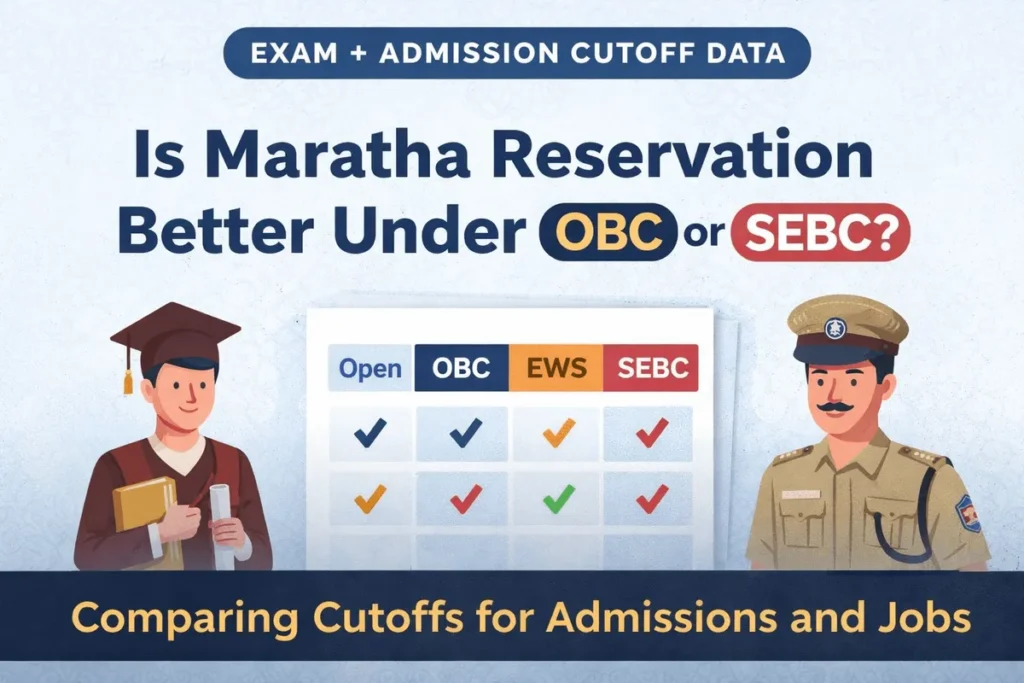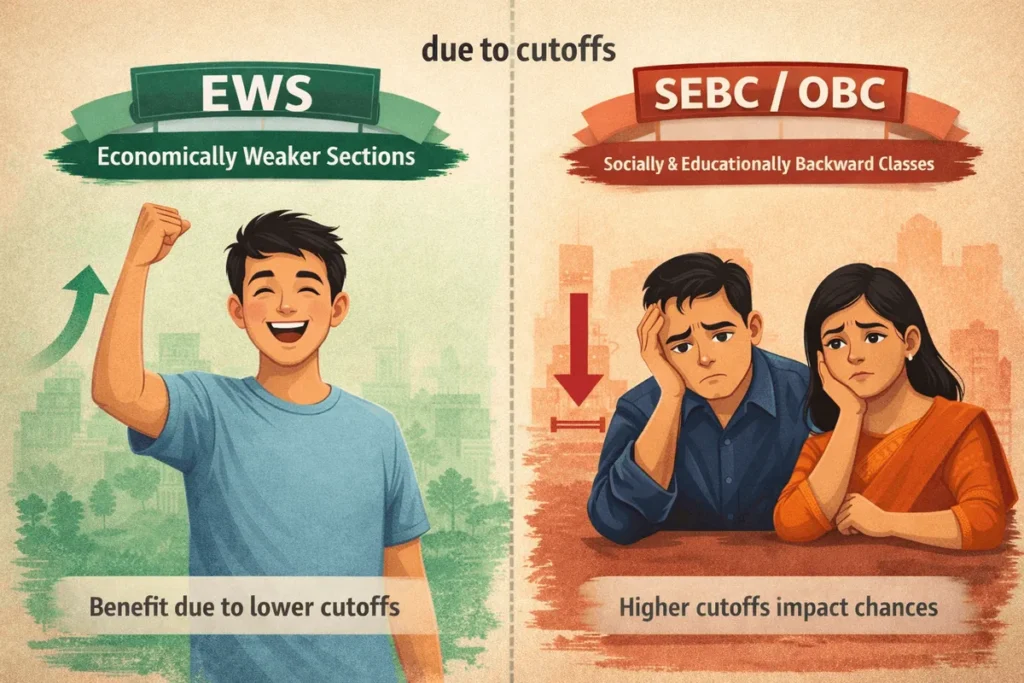
Maratha reservation is one of the most confusing topics in Maharashtra, and many people still ask: Are Marathas General, OBC, SEBC, or eligible for EWS in 2025? In this article, we clearly explain which reservation category Marathas actually fall under—EWS (Economically Weaker Section), SEBC (Socially and Educationally Backward Class), or OBC (Other Backward Class)—based on the current status.
We cover what Maratha reservation is, its background, and the present situation in 2025. You will also get answers to common questions such as whether Marathas are OBC now, whether SEBC and EWS are the same, and whether Marathas are eligible for EWS reservation in clear and simple language.
History of Maratha reservation
The Maratha reservation issue did not emerge overnight. It has evolved through multiple commissions, laws, court judgments, and political decisions. The flow chart below traces this step-by-step progression, beginning with the earliest demands for reservation.
1981–82
First Maratha reservation demand due to agrarian distress
Leader: Annasaheb Patil
Government: Congress
↓
1990s–2000s
Mandal era; Kunbis included in OBC, Marathas excluded
Government: Congress–NCP
↓
2014
16% SEBC ordinance issued; stayed by Bombay HC
Government: Congress–NCP
↓
2017–18
Gaikwad Commission & peaceful Maratha Kranti Morchas
16% SEBC Act passed
Government: BJP
↓
May 2021
SEBC struck down by Supreme Court
Government: MVA
↓
Sept 2023
Antarwali Sarati lathi-charge
Manoj Jarange Patil emerges
Government: Shinde–Fadnavis
↓
2024
10% SEBC reservation restored
Kunbi–OBC process accelerated
Government: Shinde–Fadnavis
Current Scenario of Maratha Reservation
The current scenario of Maratha reservation is complex, as Marathas today have multiple reservation options, including SEBC, OBC (through Kunbi recognition), and EWS, each with different eligibility conditions. Because of this, many candidates are confused about whether Marathas fall under General, OBC, or EWS category in 2025. The applicable category depends on factors such as community records, income limits, and government certification
At present, the reservation specifically introduced for Marathas is under the SEBC (Socially and Educationally Backward Class) category. This SEBC reservation has been enacted through a state law/ordinance and is currently under judicial review, with interim permission for implementation. Alongside SEBC, eligible Marathas with valid Kunbi records may be included under OBC, while others who meet income and asset criteria can apply under EWS reservation. The final and permanent status of Maratha reservation will depend on future judicial decisions, making it important for candidates to verify the latest notifications before applying.
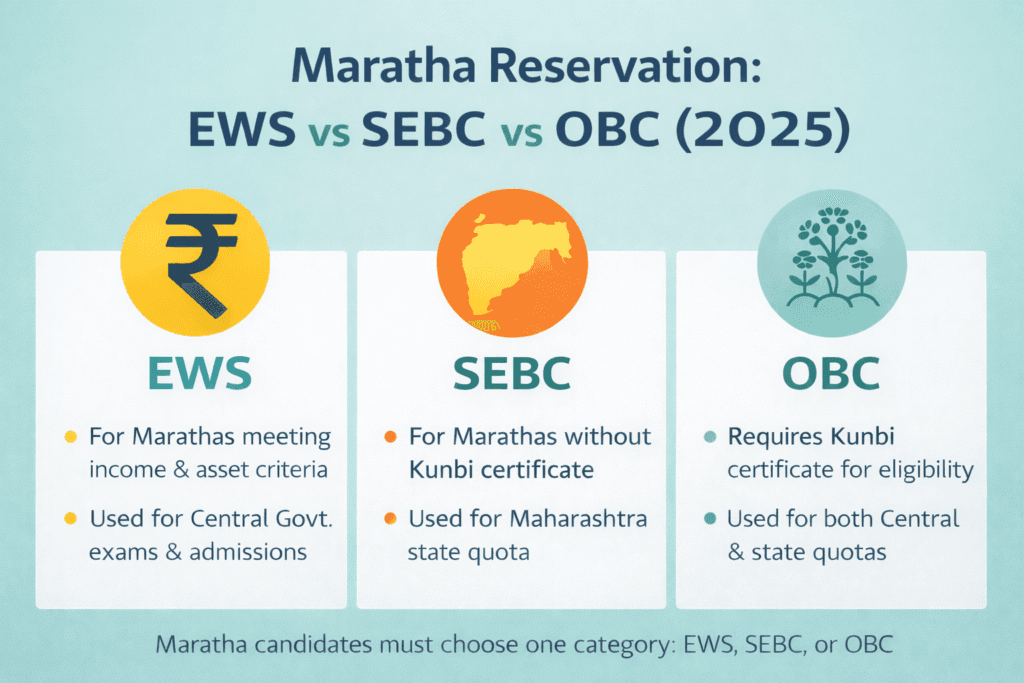
EWS vs SEBC vs OBC: Reservation Comparison for Marathas
The table below compares EWS, SEBC, and OBC reservation to help Maratha candidates understand which category applies in state and central admissions or exams. It explains the basis of reservation, eligibility conditions, income limits, applicability, and legal status of each category in a clear and simple format.
| Point | EWS | SEBC | OBC |
|---|---|---|---|
| Info | EWS (Economically Weaker Section) is a reservation based on the economic condition of individuals who are not covered under any caste-based reservation category. | SEBC reservation is provided specifically to the Maratha community in Maharashtra at the state level. Since Marathas fall under SEBC in the state, EWS reservation is not applicable to them within Maharashtra. | Maratha candidates in Maharashtra can become eligible for OBC reservation through Kunbi Nondi (Kunbi entry), provided documentary proof of Kunbi caste records in ancestral lineage is available. Once validated, the candidate is treated as OBC (Kunbi). |
| Reservation Percentage | 10% | 10% | Maharashtra: 18% Central: 27% |
| Communities Covered | Individuals without any caste-based reservation | Exclusively for Marathas | Other Backward Classes, excluding SC/ST |
| Income Limit | Below ₹8 lakh (family income) | Below ₹8 lakh (family income) | Below ₹8 lakh (Creamy Layer limit) |
| Eligibility Criteria |
The family must not own: 1. Agricultural land of 5 acres or more 2. Residential flat of 1000 sq. ft. or more 3. Residential plot of 100 sq. yards or more (within municipal limits), or 4. Residential plot of 200 sq. yards or more (outside municipal limits) |
1. Candidate must belong to the Maratha community 2. Maratha community proof dated before 1978 is mandatory 3. Creamy Layer / Non-Creamy Layer rules apply |
1. Kunbi Nondi (Kunbi entry) must exist in old school or revenue records of ancestors 2. Kunbi Caste Validity Certificate is mandatory 3. Creamy Layer / Non-Creamy Layer rules apply |
| Applicable to Marathas | EWS is not applicable under Maharashtra state quota but can be used for Central Government exams and admissions. | Applicable only for Maharashtra State Government exams and admissions. | Applicable for both State and Central Government reservations if Kunbi proof is available. |
| Applicable in State | No | Yes | Yes |
| Applicable in Central | Yes | No | Yes |
| Legal Status | Constitutionally valid | Valid till the final decision of the High Court | Fully established |
| Important Note | State EWS certificates and Central EWS certificates are different. Candidates must apply with the correct certificate as per the authority conducting the exam or admission. | Since SEBC is not applicable to Central Government institutions, candidates must apply under EWS for Central exams. | Without Kunbi Nondi, candidates must apply under SEBC for State opportunities and EWS for Central opportunities. |
Key Takeaways from the Comparison
EWS reservation is purely economic-based and constitutionally valid. It is a legally settled category and can be used by eligible Maratha candidates for Central Government exams and admissions.
SEBC reservation is the only category created specifically for Marathas in Maharashtra. Although it is under judicial scrutiny, it is currently valid and enforceable until a final court decision, and applications under SEBC are being accepted as per existing notifications.
OBC reservation through Kunbi Nondi is legally established. Once Kunbi caste records are verified and a caste validity certificate is issued, the candidate is treated as OBC (Kunbi) for both state and central reservations.
Maratha candidates without Kunbi proof generally use SEBC for state-level opportunities and EWS for central-level opportunities, subject to eligibility conditions.
Legal clarity as of now: all three routes—EWS, SEBC, and OBC—are valid in their respective scopes, with SEBC continuing to apply until the final judicial outcome.
Frequently asked questions
A. Is Maratha a general category?
Maratha is a community, not a reservation category. If a Maratha candidate does not use any reservation due to income limits or other eligibility criteria, they are considered under the General (Open) category.
B. Are SEBC and EWS the same thing?
No, they are completely different. SEBC is a reservation created specifically for the Maratha community in Maharashtra, while EWS is based only on income and assets and is meant for candidates who do not get any caste-based reservation.
C. Are all Marathas included in OBC now?
No. Only those Maratha candidates whose family records show Kunbi or Kunbi Nondi entry, and who have received a valid Kunbi caste validity certificate, are considered OBC.
D. Can Marathas apply for EWS in 2025?
Yes and no. Marathas can avail EWS benefits in Central Government exams and admission processes. However, EWS is generally not applicable for Maharashtra state government admissions, as a separate reservation exists for Marathas at the state level.
E. What exactly does Maratha reservation mean?
Maratha reservation refers to special reservation benefits provided to the Maratha community in Maharashtra. At present, this reservation is implemented under the SEBC category at the state level.
F. Is SEBC reservation still active?
Yes. SEBC reservation is currently in effect. Even though the matter is before the courts, the reservation continues to apply unless a final decision changes it.
G. Can a Maratha candidate use both SEBC and EWS?
No. A candidate can choose only one reservation category for a particular exam or admission. SEBC is used for Maharashtra state quota, while EWS can be used for eligible Central Government exams.
H. Is a Kunbi certificate needed for SEBC?
No. A Kunbi certificate is not needed for SEBC reservation. It is required only when applying under the OBC category.
I. Can Marathas use EWS for Maharashtra state quota?
Usually, no. Since Maharashtra has a separate SEBC reservation for Marathas, EWS is mainly used for Central Government exams and not for state-level admissions.
J. Is Maratha reservation legally valid?
Yes. EWS and OBC reservations are constitutionally settled. SEBC reservation is also legally valid at present and continues until the court gives a final decision.