
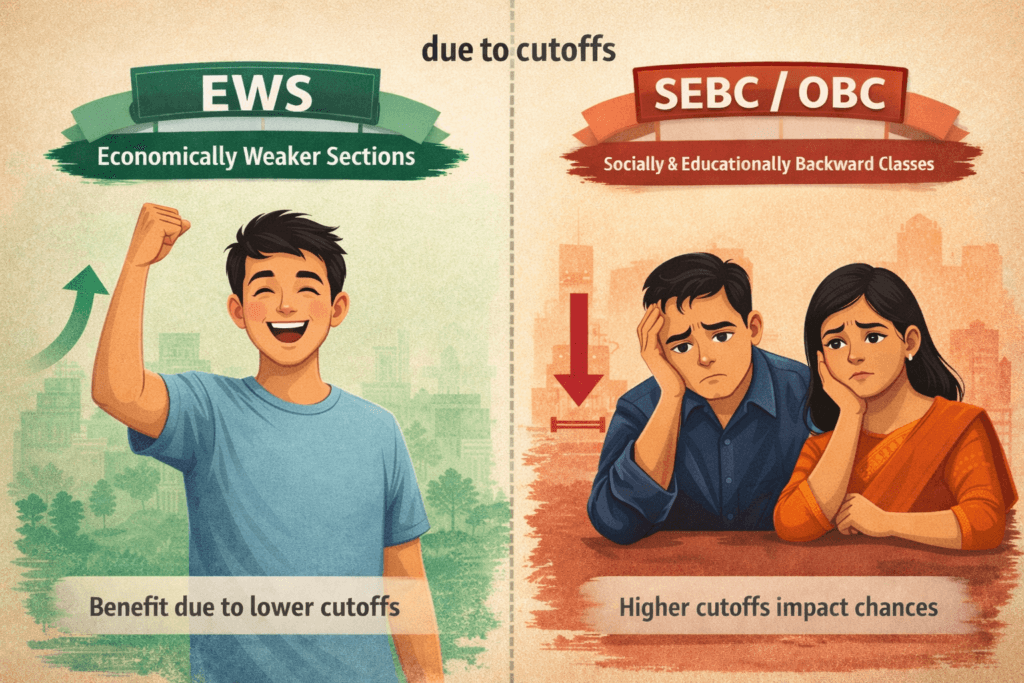
In this post, we will examine how EWS candidates are the real beneficiaries of the Maratha reservation, even though this reservation is not granted to communities other than Marathas. To reach this conclusion, we will analyze cutoff data from MPSC examinations, engineering, and pharmacy colleges admissions.
To understand this clearly, we must first look at the total percentage of reservation in Maharashtra in 2026, identify the major communities that remain within the EWS category, and determine how much reservation is left for Open category candidates
Types of reservation in maharsahtra
As of 2026 in Maharashtra, reservations are available under the following caste, group, and economic categories: SC, ST, DT(A), NT(B), SBC, NT(C), NT(D), OBC, SEBC, and EWS.
In addition to these, there are two special categories: Divyang (Persons with Disabilities) and Orphan.
Orphan candidates receive a special 1% reservation, which does not reduce seats from any other reservation category and is treated as a separate, special provision.
Divyang candidates receive a 4% reservation, which is a horizontal reservation. This means the 4% benefit is provided within the candidate’s own category. For example, if a Divyang candidate belongs to the OBC category, the reservation is adjusted within the OBC quota itself, not from the Open category.
Percentage of Reservation and peoples come into that
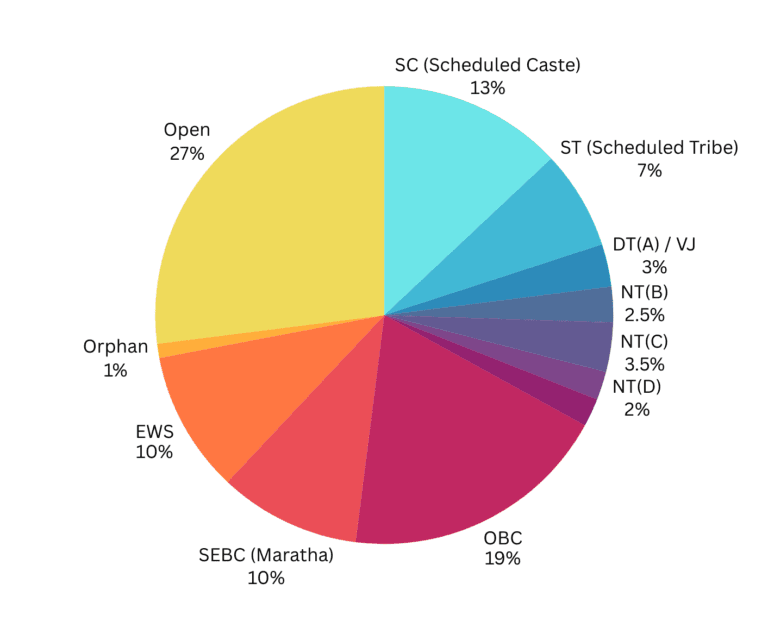
As shown in the pie chart, the reservation system in Maharashtra is divided into various categories and percentages. Today, there are 11 distinct categories that account for approximately 73% of total reservations, significantly exceeding the standard 50% cap.
These eleven categories primarily include Scheduled Castes (SC) at 13% and Scheduled Tribes (ST) at 7%, totaling 20%. The Nomadic Tribes— DT(A)/VJ, NT(B), NT(C), and NT(D)—receive 3%, 2.5%, 3.5%, and 2% respectively, totaling 11%. While Other Backward Classes (OBC) is the largest single category at 19%, it is important to note that in Maharashtra, the Nomadic Tribes and DT(A) are classified separately to ensure smaller population groups receive fair representation. Since these groups are often part of the central OBC list, the combined OBC-related reservation in the state effectively reaches 30%.
By 2018, Maharashtra’s reservation stood at 53%, including a 1% non-caste-based quota for orphans. That same year, the Central Government introduced a 10% EWS (Economically Weaker Section) reservation for lower-income individuals in the Open category, which was subsequently upheld by the Supreme Court. By 2024, the total reservation in Maharashtra reached 63%, leaving 37% for the Open category. Following the state government’s decision to grant a 10% reservation to the Maratha community, the Open category quota has been further reduced from 37% to 27%, bringing the total reservation to 73%.
Supporting data for Interpretation
For conclusion of how EWS getting more benefits of Maratha reservation Please refer the data from my reference blog where I have putted the cutoff for MPSC exams, Engineering and pharmacy college admission cutoff for OPEN, EWS, SEBC and OBC.
Interpretation
For interpretation, it was important to understand how much reservation existed in Maharashtra before 2023, how much reservation was available for the Open category, and how this structure changed after Marathas received a separate 10% SEBC reservation:
- Mattatha’s were previously competing in EWS reservation for state and central list
- After Maratha got separate reservation big chuck of competition goes reduced from EWS to SEBC.
- In the absence of Maratha population smaller population categories like Muslim (Some get reserved through OBC), brahman, Jains etc. only remained in EWS
From above points and Cutoff reference, we can interpret that:
- EWS cutoff for year 2024 and 2025 got dropped too below than OBC and SEBC. This trend follows in all the MPSC, College admissions as we looked for cutoffs.
- When Marathas was competing in the EWS, EWS cutoff used next to open category but now Marathas are competing in SEBC hence Cutoff for EWS dropped from SEBC and Even less than OBC.
- In MPSC exams we can see that EWS cutoff even went down from SEBC, OBC, NT (A, B, C) and DT/VJ.
- In college admission we can see EWS is at 4th place after open, SEBC and OBC but in some regions like Nagpur there we can see EWS cutoffs are still more then SEBC and OBC.
Conclusion
- Separate SEBC reservation taken out competition from the EWS causing EWS cutoff dropped below SEBC and OBC.
- SEBC, OBC and Other categories actually losses 10% of reservation from OPEN category causing cutoff went very high for OPEN and all reserved category than EWS.
- As interest of EWS people can be question in the government jobs causing less competition in MPSC exams and other education admission cutoffs.
- Final Verdict of High court on SEBC reservation may be change this situation in future if marathas again came in EWS.