
Introduction
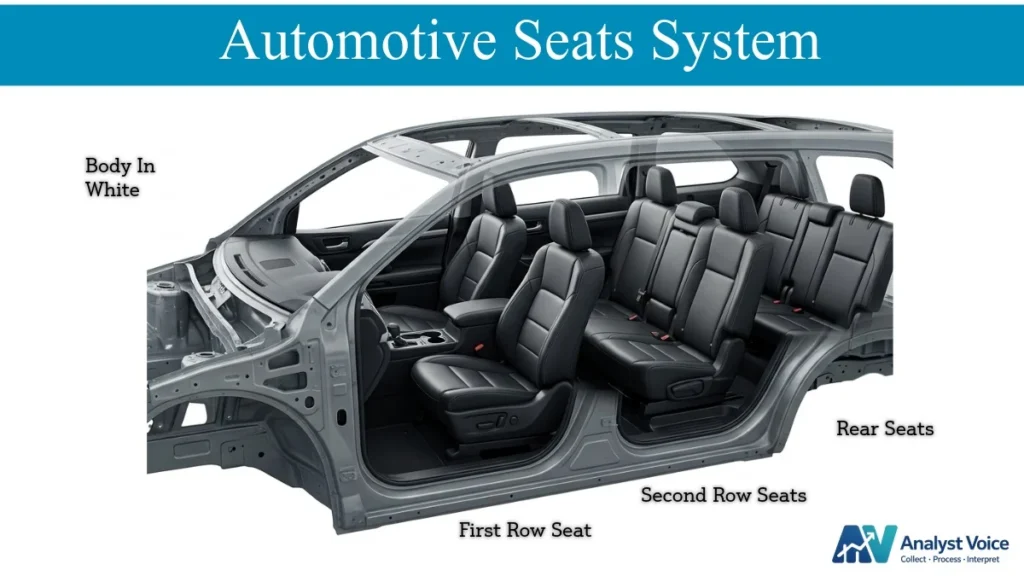
A seat system is an assembly of a metal structure, foam, plastic, trim, headrest and seat belt which is bolted to the vehicle Body-in-White (BIW) that is designed to accommodate and secure one adult occupant.
The primary function of the seat system is to secure the occupant in the seat in the case of a collision such as frontal and rear crashes keeping the occupant within the effective airbag protection zone and to provide a comfortable seating experience for driver and passenger during long journeys, secure the occupant in the seat during right- and left-hand turns and to keep passenger safe from luggage impact.

In this Article, we are going to learn the fundamentals of automotive seat systems; to make it easy to understand I have divided content into below sections:
- Basics of seat systems – Purpose of seats, seat sub-systems, Different seat row configuration and Different types of automotive seats.
- Technical Terminologies like R/H point of seats, Torso angle, Thigh angle which are related to seats.
- Basic and Premium Adjustments like Length adjustment, Height Adjustment, Lumbar support, seat heating and vibration, Recliner adjustment and other comfort functions
- Homologation standards – Introduction to regulations such as ECE and FMVSS applicable to automotive seats.
- Seat-level validation tests – Seat belt anchorage test, luggage retention test, and other important seat safety tests.
Basics of Seat System
1. Purpose of the seat
A car consists of multiple sub-systems such as engine, interior, exterior, drive and traction, braking, door-closing system and seat system. Among these, the seat system is the only sub-system that remains in continuous contact with the occupant throughout the journey, making it one of the most important systems for both comfort and safety.
There are several factors to consider when selecting a car, and one of the most important is its seating capacity. Vehicles are commonly classified as 2-seater, 5-seater, 6-seater, or 7-seater. They can also be identified by the number of seat rows, such as two-row or three-row vehicles. To understand the purpose of an automotive seat system, let’s first look at the following key functions.
Occupant Safety
As we know, when an OEM wants to launch a car in any region, it must comply with the safety regulations applicable to that region. These requirements also include frontal/rear crash, rollover, side impact and other important tests. In all of these tests, the seat system plays an important role as it works together with the seat belt and airbag to protect the occupant from hazardous situations.
The seat system contributes to occupant safety in the following ways.
- During an accident or sudden braking, the human body tends to move due to inertia. This can cause critical body parts to strike the IP panel, dashboard, steering or other interior components, resulting in serious injuries or fatalities.
The seat system helps control this movement by supporting the occupant through cushion and backrest by supporting the occupant’s hip, back and head area as it transfers inertia forces to BIW with the help of seat belt, rails, and headrest. - The seat system secures the occupant in the correct position, so the occupant always remains in a position where occupant remains within the effective airbag protection zone during a collision. This allows the airbags to provide maximum protection and reduces the risk of severe injuries.
- In the case of a luggage retention test, or during a real-life frontal or rear-end collision, luggage stored in the boot space tends to move forward due to inertia. The second-row seat is designed to resist this luggage impact and prevent the impact forces from reaching the occupants seated in the rear row.
Occupant Comfort
Occupant comfort and the overall travel experience are primarily provided by the seat system and its various features such as length adjustment, height adjustment, recliner, while some premium cars have heating, ventilation and massage functions which enhance comfort during driving in long journey. The following points explain how seat system helps with occupant comfort.
- For comfort, seat has foam and trim which prevent contact with the seat structure. Every car has a backrest and cushion which are designed considering the comfort surfaces which are based on ergonomic studies. Appropriate metal-to-body clearances are also maintained to ensure that occupants do not come into contact with structural metal components during normal seating conditions.
- While driving on winding or mountainous roads, the occupant tends to move sideways due to vehicle cornering. Seat bolsters are provided to support the occupant and reduce lateral body movement, thereby improving comfort and stability during turns.
- The seat cushion pan is designed to support the occupant during braking by transferring the inertial loads through the seat structure, reducing the tendency of the occupant to slide forward.
- Most premium vehicles are equipped with heating mats that keep the seat warm during cold weather. Ventilation systems improve airflow between the seat and the occupant’s body, while massage functions help reduce fatigue during long-distance driving.
Seat Sub-Systems
An automotive seating system is a combination of foam, trim, plastic, wire harnesses, headrest, seat belt components which have distinct purposes, but their combined aim is to provide comfort and safety through manual and power adjustment systems.
- Foam – Foam is a soft material which deforms according to the human body and regains its shape when the load is removed. So, foam plays a vital role in providing comfort during long journeys. Foams are designed considering comfort surface, minimum wall thickness, meat to metal distance which is the dummy-to-metal distance and the required distance to the H-point.
- Trim – It is the outermost part of the seat which gives an aesthetic appearance and a comfortable feel to the end user. It also functions to secure the foam to the metal structure. For this purpose, hog rings and retainers are hooked onto wire or metal parts, they hide the foam-to-metal interface.
- Metal Structure – It is a load-carrying element of the seat which carries the passenger’s load and also transfers impact loads to the BIW during an accident. It is mainly divided into cushion structure and backrest structure, which are assembled with the use of marriage bolts. All movements, such as height and length adjustment, also have hard points on it, which makes it the heart of the complete seat.
- Headrest – As the name suggests it has to support the head while driving and to restrict the movement of the head during an accident. It is an important part as per safety, so it also has standards that need to be followed by every OEM, such as ECE R17, R25 FMVSS 202A which specify the relevant requirements.
- Seat Belt system – It works by transferring inertia force during an accident to make sure the occupant remains in place. The seat belt system requires 3 hard points to transfer force to BIW and in most cases these points are located on BIW or one is located on the seat and two are located on the BIW. when we provide hard points on the seat on it will add weight as we need to strengthen the seat structure due to high forces.
- Wire Harnesses – Seats are available in both manual and powered versions. To have functions like powered height adjustment, length adjustment, recliner, heating, and massage functions, electrical actuators are used. High-end cars also have a memory function, which needs electrical power as well as memory position commands, which are fulfilled through the wire harness.
Different Types of Seats
Automotive seats can be differentiated in different ways, such as by the number of seat rows, the facing of a seat, configuration, and the way of powering adjustment devices. It is important to differentiate seats, as most of the time the design intent is to have a symmetric design, which can reduce the material number and help OEMs or suppliers lower the prices. Below are the main points of differentiation used by product engineering and customers to classify the seats.
1. According to Driving Power
In recent days most of the seats come with basic features of length, height adjustments and recliner and also premium cars have features like cushion extension, leg support, and headrest adjustment. For these adjustments, we have either manual adjustment or switch-driven actuation which requires electrical power. So, we can classify them as follows
- Power Seat
- Manual Seat
2. According to Position of Seat
Seat position is an important classification criterion for car owners as this is the most common categorization used by end users and product engineers. We further sub-categorize this into two categories such as side of the seat and facing of the seat.
- Side of the seat
1. Driver Seat
2. Passenger seat
3. LH/RH Seat - Facing of the seat
1. Forward-facing seat
2. Rearward-facing seat
3. Side-facing Seat
3. According to Seating Row
Car seat rows also a one of the advertisements point for OEM and one of the option customers consider while buying a car for nuclear and joint families as its directly connected with the seating capacity
- First Row Seat
- Second Row Seat
- Third Row Seat
4. According to design of seat
Every seat is designed considering the available space, type of car, buyers’ mindset and number of seat rows in a car. There are multiple types of seats which can also be positioned in first row or second row.
- Captain/Bucket Seat
- Bench Seat
5. According to Configuration
Each row in the car can have space for two or three person and that depends on what seat configuration we have in each row. In the front row most cars are a seating capacity of two, and SUV/truck may have 3 also. So, to do that captain/bucket seats are placed in a different combination which are shown below.
- 50% 50% seat (Two Captain Seat)
- 40% 20% 40% (Two captain seats with space in the middle for a child)
- 40% 60% (Captain Seat + Bench Seat)
6. According to Way of Adjustment
For comfort traveling automotive manufactures provide different types of adjustment in seat and each adjustment has translating and rotating motion in two directions and from this each seat can be classified as follows
- Two-Way seat (Either front and rear movement of seat or up and down)
- Four-Way seat (Both front and rear movement of seat or up and down)
- Six-way seat (Height, Length and Recliner)
Technical terminologies
In a seat there are multiple angles, points, distances/movements, and nomenclature used to measure, maintain and validate. Some of them are important to meet tolerance guidelines, comfortable position, accessibility to control system and approval from government authority and some are important to highlight the parts, sides and direction of seat and some are important for kinematic study of seat. We can categorize all the four terminologies in four section which are below.
| Angles | Points | Distances/Movement | Nomenclatures |
|---|---|---|---|
| Torso Angle | H point | Envelope curves | LH/RH Drive |
| Thigh angle | R point | Height/length adjustment | Door side/Tunnel side |
| Leg angle | Seat design point | Cushion tilt/extension | Indoor side/Outdoor side |
| rail angle | Recliner movement | ||
| Cushion angle | Headrest Height/Length adjustment |

Seat adjustment functions
In automotive seat systems, we have different functionalities based on the base, mid, and premium versions. For example, in the base version, we will have manual height and length adjusters. In the mid version, we will get power height and length adjusters, and in the high-end version, we will additionally get functions like massage and other advanced functionalities. So, below are the adjustment functionalities available in a seat.

1. Length Adjustment
Length adjustment can be done through both manual and power drives, the available functionality depends on the variant, segment, and target audience of the car. The function of length adjustment is to move the seat back and forth (2W movement) within a 200–300 mm range. This allows the passenger to create legroom according to their body measurements. The length adjustment drive is mostly provided in the rail, which is maintained at a 2–5-degree angle.
2. Height Adjustment
Height adjustment is also possible with both power and manual drives, and most OEMs or suppliers use a 4-bar mechanism for height movement of 50–80 mm up and down. As we use a 4-bar mechanism, this movement is always rotational and not exactly in the Z direction. This allows the occupant to adjust the seat height for a better view.
3. Cushion tilt
The cushion pan is a separate part that is attached to the side arms of the cushion structure. In this function, the cushion pan can be tilted by a certain number of degrees to provide better support to the thighs and legs. It has two movements, clockwise and anticlockwise, so it is also considered a 2W movement.
4. Leg support and extension
This function can come with only angular movement or length extension, or it can have both angular rotation and extension. Therefore, it is also considered a 2W and 4W function. This allows the user to have extra support for their legs, which is most commonly found in higher variants.
5. Recliner
This also has manual and power variants, which allow the user to adjust the backrest according to their needs. The drive for it is provided in the lower part, where the backrest is connected to the cushion structure, and it can rotate clockwise and anticlockwise. Therefore, it is also considered a 2W movement.
6. Headrest
The headrest can also be considered as 2W or 4W, as it comes with either height adjustment or both height and X-direction movement. Height adjustment allows users to adjust the headrest according to their height, and X movement can provide additional support to the head by minimizing the gap between the head and headrest.
These are the main functionalities provided in cars, but there are many more futuristic functions that OEMs are introducing nowadays, such as massage functions, cushion and backrest heating and ventilation, memory functions, and comfort seats that combine backrest adjustment, cushion tilt, and extension to provide a feeling similar to sitting on a bed.
Homologation Standards for Seat
Before launching a vehicle in any market across the globe, OEMs must follow the safety standards and regulations set up by government bodies or automotive authorities, such as FMVSS for the United States and UN ECE regulations for Europe. Similar regulatory requirements exist across global markets and must be followed by all OEMs before a vehicle can be introduced.
Being a major contributor to occupant safety and comfort, seat systems also have to follow standards for occupant safety, belt or child seat anchorages, strength of the seat, head restraints, luggage retention, frontal/lateral collisions, etc. Therefore, seat designs must be confirmed and follow the applicable requirements before vehicle launch.
The following are the standards that are related to seat system design.

1. Safety Belt Anchorages
We need three hard mounting points for our safety belt, which are either on the BIW or on the seat. These points are defined in areas which are described in regulatory standards. These regulations also regulate the buckle position and loading conditions on the seat belt, which are applied during a crash.
ECE R14, FMVSS 209 and FMVSS 210 are the standards which describe safety belt anchorage requirements.
2. ISOFIX and Child Restraint Systems
This standard talks about ISOFIX position, wire diameter, clamping length, loading conditions and passing criteria. ISOFIX is a rod where the child seat is attached, and top tether is an anti-rotating device. For these points, regulations define areas which are easily accessible.
ECE R145, R129(formerly R44) and FMVSS 213, 225 are examples which describe child seat anchorages and restraints.
3. Strength of Seats, Head Restraints and Luggage Retention
Sharp edge protection areas (radius requirements), head restraint height requirements with adjustable or integrated headrests, H-point fields, testing requirements and loading conditions for adjustable mechanisms are described in these requirements.
ECE R17 is one of the examples of these requirements, which describes the points mentioned above.
4. Head Restraint
Different types of headrests for front-facing seats, minimum height and width requirements, minimum distance between the headrest and seat back, maximum allowable rearward displacement, and energy absorption test requirements are mentioned and need to be followed.
ECE R25 has these requirements mentioned.
5. Collision Protection
Frontal collision protection, lateral collision protection, side-impact protection, roof-crush resistance test procedures, and passing criteria are mentioned in the applicable requirements.
ECE R94, R95 and FMVSS 214, 216 cover these requirements.
6. Flammability of Materials Used in Interiors
In the interior system of a car, materials such as trim, foam, and plastic can catch fire under certain conditions. To limit the risk, applicable interior materials must meet the required flammability limits to reduce the possibility of injuries.
ECE R118 and FMVSS 302 describe the requirements related to flammability.
Seat Level validation Tests
An automotive seat is a combination of various components and materials, including metal structures, plastic parts, foam, trim covers, and sub-assemblies. Therefore, seat validation is conducted at various levels, such as part-level testing, sub-assembly-level testing, and complete seat testing.
A seat validation phase may include static strength tests, dynamic crash tests, durability tests, fatigue tests, comfort, and ergonomic assessments, NVH (Noise, Vibration, and Harshness) evaluations, climatic and environmental tests, flammability tests, and airbag-integrated seat tests.
However, this section focuses only on the homologation tests, which are mandatory for regulatory approval and certification of the seat. The key homologation tests are listed below.
1. SBA (Seat Belt Anchorages) test
This test ensures that the seat belt anchorage points will not fail in the event of sudden braking or a crash. In this test, a 13.5 kN load is applied to the lap and shoulder belts simultaneously for a specific duration of time. There should be no rupture, separation or failure of seat belt anchorages or supporting metal structure of seat or BIW.
2. Seat Structure
- Seat Back strength test – It verifies the strength of the backrest and recliner mechanism under occupant loading. It is tested against the 53 daNm rearward momentum “which is applied to the backrest and passing criteria is no failure or breakage of seat frame, seat backrest and locking mechanism.
- Seat anchorages strength test – This test is to ensure the seat remains securely attached to the vehicle during a collision. A 20 g frontal deceleration is applied for 30 ms and no failure of seat anchorages, separation of the seat from the vehicle structure and seat remain attached to the vehicle body are the passing criteria.
- Adjustment system strength test – This test verifies the strength of seat track which is the length adjuster, height adjuster and other adjustment mechanism during the crash loading. This is tested alongside the anchorages test with 20 g crash pulse. Adjustment mechanisms shall not fail structurally under prescribed loading.
- Locking system strength test – This test ensures that adjustment locks for functions such as length-adjustments; height-adjustment locks remain engaged during a crash and passing criteria is to no unintended unlocking or release of seat locking mechanism.
- Displacement system test – This ensures the functionality of displacement systems such as easy entry, folding mechanism, armrest and is tested under crash-loading conditions and the passing criteria is no release of such system during impact and mechanism remains operational after testing.
- Seat back energy dissipation test – This reduces the injury risk to rear passengers due to the impact of seat backrest. 165mm of head foam is stuck at the speed of 24.1 km/h onto the backrest and passing criteria is to deceleration less than or equal to 80 g for not more than 3ms and no dangerous radius created into impact area.
- Luggage retention tests – It prevents luggage from the backspace don’t get hit on rear passenger at the frontal crash. Test boxes of specified sizes strike at the speed of 50 km/h and the passing criterion is that the locking system of backrest remain intact and luggage box stay behind the seat.
All the values provided here are from UN ECE standards and may vary as per region and country.
3. Head restraint test
The purpose of the headrest is to restrict excessive head movement in the case of crash or sudden braking, so headrest testing has separate standards like UN ECE R17/25 and it includes the following tests.
- Headrest restraint height test – This ensures that headrest is high enough above the R point to support the occupant’s head and reduce whiplash injuries. The passing criterion is 800 mm for front seat and 750 mm for second row seat.
- Head restraint width test – It ensures that the maximum support provided to the occupant from the headrest. Passing criteria is to pass 85 mm on each side from center line.
- Backset test – It measures the distance between head and headrest extreme points. Smaller distances improve whiplash protection. Passing criteria is to comply with specific dimensional requirements.
- Headrest restraint retention – It measures how far the headrest moves rearward under application of load and passing criteria is to maximum movement most be less than 102 mm.
- Gap Measurement test – It measures gap between two points on seat above 540 mm of H point and it is measured using a 165 mm ball and it measures distance between two contact points, and it should not be more than 60 mm.
Conclusion
- Automotive seats are not just about comfort; they contribute significantly to occupant safety. In this blog, we looked at the purpose of the seat system, its basic subsystems, technical terminologies, homologation standards, and validation tests.
- Here, we have only touched on these topics so that anyone starting their journey in seat design, as well as automotive enthusiasts, can gain basic knowledge about seat subsystems, adjustments, terminologies, regulations, and mandatory validation tests.
- This blog is intended to provide a basic understanding of automotive seat systems. We will add more detailed blogs covering each technical aspect in depth, so readers can explore individual topics in greater detail.