
Seat systems are an important part of a vehicle because they directly contribute to occupant comfort and safety. Automotive seats are available in different designs and configurations depending on end-user requirements and the vehicle’s market segment. OEMs decide the seat configuration based on the target audience and vehicle variant, such as base, mid, and high-end variants. In this article, we will explore the different types of automotive seats, including bucket seats, captain seats, complete bench seats, and different split-bench configurations.
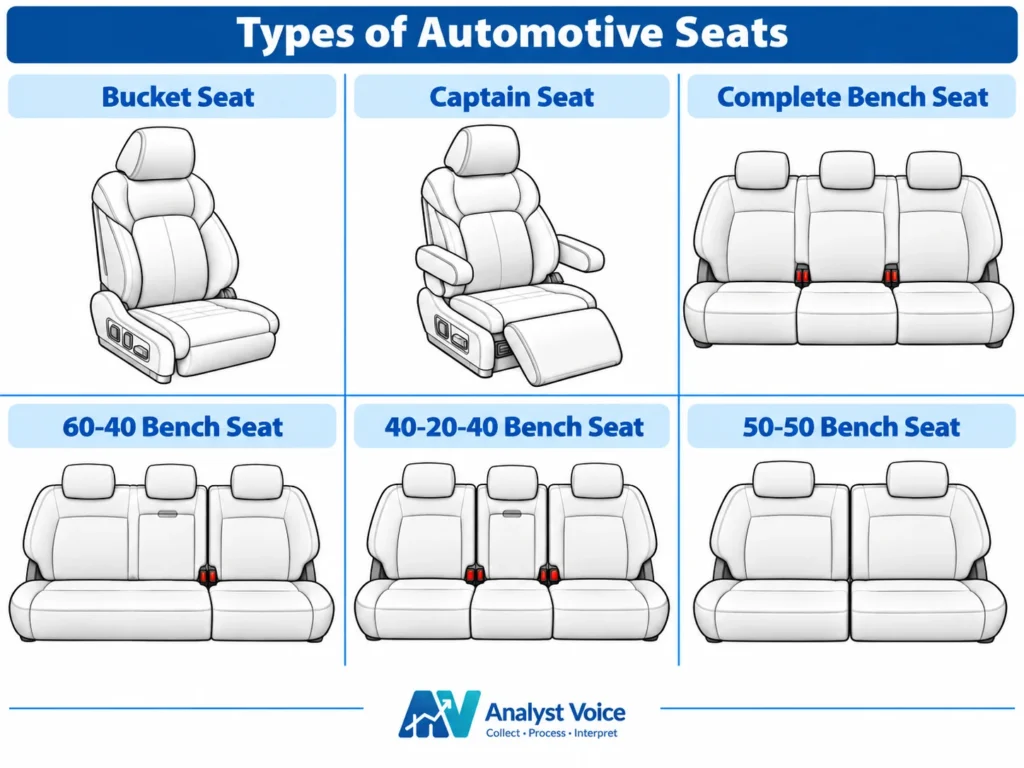
Types of seats
1. Bucket / Captain seat
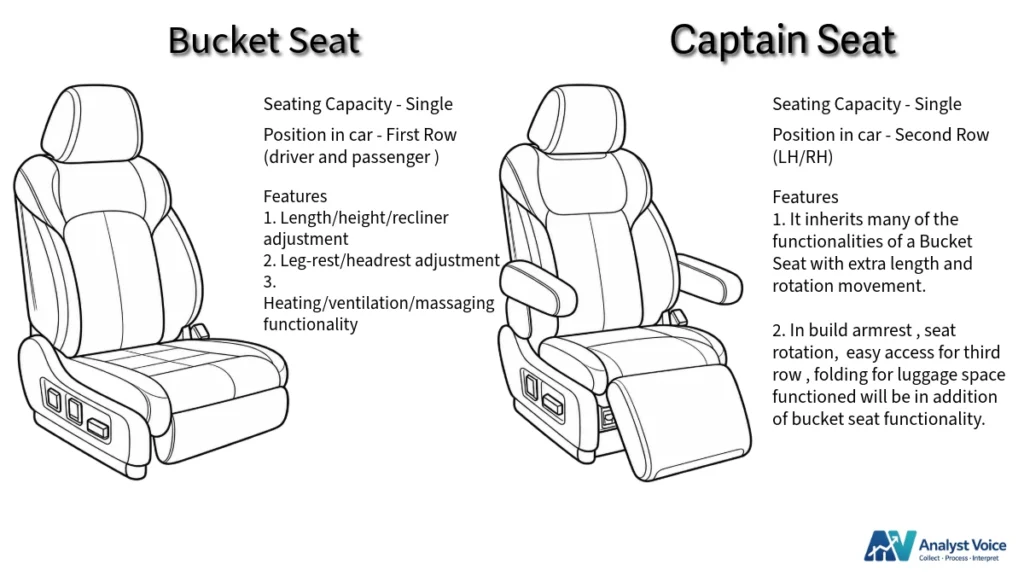
Most people call a bucket seat and a captain seat parallel terms to describe a seat that is designed for single occupancy. Even though the design is mostly the same for both, they do have differences in functionality, features, and position in the car.
Bucket seat
- A bucket seat is designed for the safety and comfort of a single occupant and is mostly present in the front row for the driver and passenger.
- A bucket seat is designed with safety and comfort in mind, with functionalities such as length/height/recliner adjustment, leg-rest, headrest adjustment, heating, massaging, and ventilation.
- The size and weight of this seat can be lower than those of a captain seat due to packaging constraints and fewer parts.
- Bucket seats are mostly present in the front seat row as individual seats, where the center console will be in-between of both bucket seats.
Captain Seat
- A captain seat is designed for the safety, comfort, and luxury of a single occupant and is mostly present in the second or third seat row with more comfortable features.
- It shares many of the functionalities of bucket seats, with advanced features like armrests, swing seat, easy-entry functionalities to access the third row, more adjustment travel for length, height, recliner, leg-rest, and headrests, and can also be foldable for more luggage space.
- The size and weight of this seat can be higher than a bucket seat as it has more luxury functionalities and more packaging freedom than the first row.
- Captain seats are mostly present in the second and third seat rows in 6-seater or 7-seater variants of a car. This seat can also be considered as individual seat.
Bench seat
A bench seat is designed to accommodate 2–3 occupants and is mostly used in the second and third seating rows. However, in some cars, it is also used in the first seating row in combination with bucket seats.
1. Complete bench seat
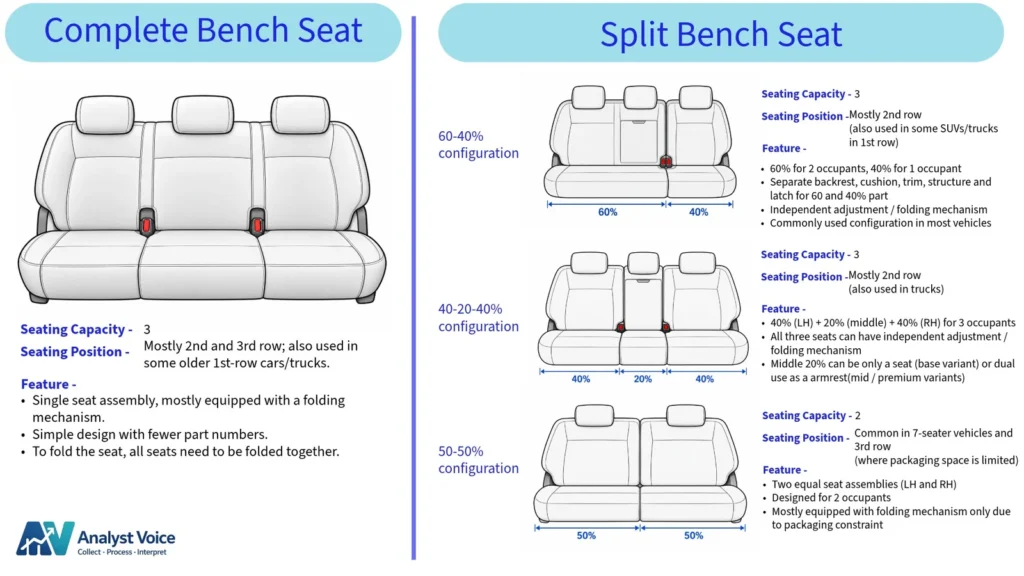
The complete bench seat is a single seat that is designed to accommodate 3 occupants. Most of the time, this seat is equipped with only a folding mechanism and is widely used in older cars and trucks. In recent trends, such seats are no longer commonly used due to advanced features and folding mechanisms; instead, different split configurations are used.
The advantage of this seat was that it was simple in design and had fewer part numbers, but if you wanted to fold it, you needed to fold all the seats together.
2. Split bench seat
A split bench seat is the advanced version of a complete bench seat, which is designed to accommodate advanced features like folding mechanisms, length adjustment, backrest adjustment, armrests, etc. This seat is mainly divided into 3 categories: 60–40%, 40–20–40%, and 50–50%.
Such configurations can be seen in the 1st, 2nd, and 3rd seat rows and provide the advantage of folding the seats independently, which is not available in a complete bench seat.
1. 60-40% configuration
When the entire bench seat is divided into 2 different assemblies in a 60% and 40% ratio, then it is called a 60-40% configuration. Such a configuration is the most commonly used in the 2nd seat row for passenger vehicles, and some SUVs or trucks also provide such a combination in the 1st seat row.
The 60% section is suitable for 2 occupants, and the 40% section will be for 1 occupant. Both parts have separate backrest/cushion foam, trim, structure, and latch, allowing them to be adjusted/folded separately. The 60% part will be a complete block having a comfort area for 2 occupants, while most of the parts from the LH and RH seats will be symmetrical; only the middle seat will be integrated within the 60%. As we know, cars that come with base, mid, and premium variants provide an armrest option in mid and premium variants as an additional feature, which will be integrated into the middle seat, or we can see it on the 60% side.
2. 40-20-40% configuration
When the bench seat is split into 3 parts in the proportion of 40-20-40% for LH, middle, and RH seats, then it is called a 40-20-40% seat. Such a configuration is widely used in the 2nd seat row in passenger vehicles as well as trucks.
The 40% seats on the LH and RH sides and the 20% middle seat are combined and designed for a seating capacity of 3, but all three seats can be equipped with independent adjustment/folding mechanisms, which allow users to fold the seats and create space while keeping the other seats intact. In the base variant, the 20% will be only for seating, while in mid/premium versions, it can also be designed for dual use as a seat as well as an armrest.
Why do manufacturers use 60:40 or 40:20:40?
The choice between 60:40 and 40:20:40 is also related to the number of parts, features and mechanisms required in the seats.
In a 60:40 configuration, there are two independently managed sections, where the 60% is built in a way that it will have a common structure and foam, but trim, stitches and bolsters make it feel like both are separate parts. Therefore, the system can be relatively simpler compared with a 40:20:40 configuration. But if OEM picks an armrest as a feature into it, then they need to install a separate armrest mechanism to backrest, which will add cost to the BOM.
In 40:20:40, the number of parts and latches will be more because the 20% centre section also needs to work independently. But OEMs still use this configuration because it provides more flexibility in how the centre seat, which is 20%, can be used as an armrest/cupholder or extra space for lengthy objects like a surfboard, etc.
3. 50-50% configuration
In older cars, a single, continuous bench seat was commonly used to accommodate three occupants. Nowadays, bench seats can also be split into multiple configurations, such as 50/50, 40/20/40, and 60/40, to provide greater flexibility in seating and cargo space.
When a bench seat is split into two equal sections, it is called a 50–50% configuration. Such a configuration is widely used in 7-seater vehicles and for the 3rd seating row, where packaging space is limited.
Both the LH and RH 50–50% seat sections are combined and designed for 2 occupants, with minimum sub-assemblies, as this seat is mostly equipped with a folding mechanism due to packaging constraints.
Frequently Asked Questions
1. What are the names and types of seats present in a car?
We can differentiate seats into multiple sections, but if we talk from a design perspective, then the types include bucket seats, captain seats, and bench seats (complete bench seat and split bench seat (50-50%, 60-40%, 40-20-40%)).
2. Are captain seats and bucket seats similar?
No, although a captain seat can share some parts and functionality with a bucket seat, a captain seat can have more adjustment functionality and travel as it is used in the second row (more packaging space), while a bucket seat is used in the front row (less packaging space).
3. What is a bench seat in a car?
It is a seat designed for a seating capacity of 2–3 occupants, which can be redesigned into different types to have independent folding mechanisms, adjustments, and other premium functions like armrests, cupholders, etc.
Conclusion
- We have covered the basic types of automotive seats and their configurations available in the current market, which are bucket seats, captain seats, bench seats, and their various configurations.
- We can differentiate seats on the basis of power-adjustable features, the number of adjustments provided, position, and side in the vehicle, but to keep it simple, we have covered seats according to their design.