
Seat systems are an important factor when making a decision to own a car or while designing seats for a car. Every OEM provides various Automotive Seat configurations and combinations regarding seats, seat rows and seating capacity to attract buyers.
As a buyer or designer, it is better to have an idea about what types of seats are mostly used in the current market, what naming conventions are used, how seat rows are configured, and how seating capacities of 5, 6, 7 and 8 are managed with different types of seats and row combinations.
For types of seats, you can refer to my dedicated blog –Types of Automotive Seats and Their Configurations
So, in this blog, we are going to cover the below points.
Seat naming conventions in a car
Seat naming as per driving
1. Driver side seat
When the seat position is facing front, rear or side and is on the side where we can have access to the steering wheel, acceleration and braking pedals, it is called the driving-side seat. If we take the global coordinate axis and divide the whole car by the ZX plane, then the steering wheel side becomes the driving side. Irrespective of the 1st, 2nd or 3rd row, all the seat positions on the driver side become driver-side seats.
2. Passenger side seat
When the seat position is facing front, rear or side and is positioned on the opposite side where we can have access to the steering wheel, acceleration and braking pedals, it is called the passenger-side seat. The opposite side of the steering wheel side becomes the passenger side. Irrespective of the 1st, 2nd or 3rd row, all the seat positions on the passenger side become passenger-side seats.
3. Center seat
The seat positioned between the driver side and passenger side is called the center seat. In other words, we can also say that if a seat is designed exactly symmetrically to the global ZX axis (not always necessary), it is the center seat. For example, in the 40-20-40% bench split seat, 20% is the center seat.

Seat naming as per Right and Left side
1. Left hand seat
A seat which is placed on the left-hand side of the normal ZX plane from the global coordinate system of the car is called the left-hand seat (LH).
2. Right hand seat
A seat which is placed on the right-hand side of the normal ZX plane from the global coordinate system of the car is called the right-hand seat (RH).
3. Center Seat
A seat which is designed symmetrically to the ZX plane is called the center seat or, in easy words, we can say that the seat which is in between the right seat and the left seat is the center seat.

LH/RH is the most common terminology used in the engineering world. LH, RH and center-seat logic can apply to all the seat rows. 40-20-40% bench is a good example where 40% on the left side of the ZX plane will be the left seat, 40% which is on the right side will be the right seat, and 20% will be the center seat as it’s in between the right and left seats.
Can we say that both naming conventions are the same and can be used interchangeably?
No, as we are defining the naming considering the common ZX plane, but naming conventions by driving position tend to change due to the driving side of vehicles, whereas LH/RH definitions tend to be universal and don’t change.
In some context, if the car is right-hand driven, then we can say that LH/RH and driver/passenger become the same identification, but it differs when the car is left-hand driven.
LHD (Left hand driven) VS RHD (Right hand driven)
Left hand driven (LHD)
Countries where cars are driven on the right side of the road will get the driving mechanism, like the steering wheel, accelerator and brake pedals, on the left side of the car.
As the steering wheel is given on the left side of the ZX plane, left-side seats become driver-side seats and the right side of the ZX plane will become passenger-side seats.
Countries like Germany, France, the US, Canada, China, Russia, Brazil, South Korea, etc. follow the LHD rule.
Right hand driven (RHD)
Countries where cars are driven on the left side of the road will get the driving mechanism, like the steering wheel, accelerator and brake pedals, on the right side of the car.
As the steering wheel is given on the right side of the ZX plane, right-side seats become driver-side seats and the left side of the ZX plane will become passenger-side seats.
Countries like India, the UK, Japan, Australia, New Zealand, Indonesia, Malaysia, etc. follow the RHD rule.

As the whole world is divided into LHD and RHD, every OEM needs to plan the car considering the laws followed in the country. If we take examples of Volkswagen Golf, Hyundai Creta / ix25, and VW Polo, they are sold in both the RHD and LHD markets with their respective configurations.
1st, 2nd and 3rd Seat Rows: Automotive Seat Configurations and Combinations
Most passenger vehicles in the market, which have a 2–8 seating capacity, start from the 1st seat row and can go up to the 3rd seat row. A single row can accommodate a maximum of 3 and a minimum of 1 occupant. Automobile companies use various combinations of seats and seat rows to have 2–8 occupant seating capacities.
If we take examples of Hyundai Alcazar, Tata Safari and Volkswagen Atlas, they come in 6- or 7-seating configurations. Their shorter versions, such as Hyundai Creta, Tata Harrier and Volkswagen Atlas Cross Sport, come in 5-seater configurations.
So, here we will first understand how seat rows are configured with different types of seats to achieve various seating capacities and functionalities.
1st seat row
The first row is a driving row of every vehicle and can consist of either 2 seating capacity or 3 seating capacity. Hatchbacks, MPVs and SUVs are mostly equipped with 2 seating capacity, which are driver and passenger seats, and 3 seating capacity configurations are mostly used in some SUVs, trucks and vans, which consist of driver, passenger and center seats. Common possible configurations which are used in 1st rows are 2 bucket seats, 60% bench seat + bucket seat, and 40-20-40% split bench seat.
- 1+1 bucket seat – 2 symmetrical bucket seats as the driver seat and passenger seat are widely used as a configuration in recent cars. These are designed symmetrically for a better look and to reduce development, testing, validation and tooling costs. Bucket seats are generally used in front rows (if a similar individual seat is used in the second row, it can be called a captain seat, which is generally larger and provides more space and comfort than a typical front-row bucket seat) and are equipped with functionalities like height adjustment, length adjustment, leg-rest rotation/extension, backrest tilt, headrest adjustment, heater, ventilation and massager, and can be available with both manual and electric adjustments. Some vehicles use the center console as an armrest or cup holder, which is located in between both seats.
Most passenger vehicles in current trends use 1+1 bucket combinations in hatchbacks, sedans and SUVs, for example, Volkswagen Golf, Toyota Hyryder, Hyundai Alcazar, Tesla Cybertruck, etc. - Bucket seat + 60% bench seat – This combination is used for 3 occupants considering passenger, driver and center seat. Driver-side and passenger-door-side areas are kept symmetrical for a better look, but it may not contribute to cost as much as the 1+1 bucket seat combination (as both sides will look similar from the exterior, but the metal structure will be different). Both the seats can have similar functionalities like length, height adjustment, backrest tilt and adjustable headrest, or variable functions, as bench seats are generally designed with fewer functionalities than bucket seats. The center seat is used as an armrest and cup holder if it is integrated into the 60% bench seat.
The bucket seat + 60% bench seat combination is not widely used in sedans, hatchbacks or any small cars, but is used in pickup trucks or SUVs where people want more luggage space at the back, for example, Volkswagen Crafter, Mercedes-Benz Vito and Ford E-Transit. - 40-20-40% bench seat – This combination is also used for 3 occupants considering driver, passenger and center seat. Driver and passenger seats are designed symmetrically, and the center seat is given as an addition instead of a center console. This combination is mostly used in SUVs/trucks and can be equipped with length/height adjustment, while the center seat can be used as an armrest/cup holder, folding mechanism for more space, backrest tilt, headrest adjustments, etc.
40-20-40% bench seat is again famous in trucks and SUVs, for example, Chevrolet Silverado, GMC Sierra, Ford Super Duty.
So, 1+1 bucket seat is the combination used in most of the cars today, but pickup trucks and a few SUVs still have bucket + 60% bench and 40-20-40% bench seat combinations to have additional seating capacity. Designing a seat in the front row is more complicated due to less packaging space, as we have interfaces with the door, center console, instrument panel, steering wheel, AC vent, etc. Front seats mostly offer more advanced adjustment and comfort functions than any other row of the car.

2nd Seat Row
The second-row seat is for passengers and has more packaging space than the front-row seats. It can accommodate 2 or 3 occupants, as per the different seat configurations provided. Many OEMs provide 3-seating capacity for the 2nd seat row as a default option and give 2-seat capacity as an optional feature for people who want a more comfortable and spacious experience in the second seat row. If we look at current cars that provide 2-seat capacity options, they are mostly 6- and 7-seater vehicles, for example, Hyundai Palisade Calligraphy, Jeep Grand Cherokee L, Kia EV9 and Volkswagen ID.6.
To have 2 or 3 seating capacity in the 2nd row, OEMs use different types of seat combinations, like 1+1 captain seats for 2 seating capacity and 60-40, 40-20-40 split bench seats and complete bench seats for 3 seating capacity.
- 1+1 Captain seat – These seats are similar to the bucket seat combination, with more spacious, more angular or translation motions for adjustments, integrated armrests, a swivel mechanism and easy-entry functionality to access the 3rd row. Captain seats are designed symmetrically for better looks and to have fewer part numbers in the BOM to reduce tooling, development and documentation work.
Captain seats are also assembled in the car symmetrically to the ZX plane and may be given an easy-entry feature to access the 3rd row or may have space in between both the seats. Volvo EX90 Ultra, Rivian R1S, Maruti Suzuki XL6 - Complete or split and bench seats – For 3 seating capacity OEM tends to use complete bench or split bench seat. Split seats are becoming more common than complete bench seats, but we still get these options in low-budget cars. In split seats possible configurations used are 60-40%, 40-20-40% which are used as passenger side, driver side and center seat.
Folding mechanism, easy access functionality, and armrests with cup holders are the most common functionalities we get in the 2nd seat row.

3rd Row Seat
3rd seat row can only be seen in 6-, 7- and 8-seater variants, and the seat combination used in it will either be fixed or have a folding mechanism to create luggage space. Most cars have limited packaging space for designing the 3rd-row seat, and these seats can be accessed by moving the second-row seats or the middle portion of 1+1 captain seats. Using different types of seats and seat combinations, we get 2 or 3 seating capacity. Rivian R1S (7 Seater), Volkswagen I.D6(6-seater) and Chevrolet Tahoe (8 Seater).
In the current trend, we can see 50-50% seats, 60-40% bench split seats and 40-20-40% seats to have 2 and 3 seating capacity.
1. 50-50% seats- These seats are symmetrical to the ZX plane and are placed adjacent to each other to have 2-occupant seating capacity and can be seen in 6- and 7-seater vehicles. Due to packaging constraints, these seats are most times equipped with only a folding mechanism towards the front or may fold towards the side. Volkswagen ID.6 (6-seater), Hyundai Alcazar (7-seater), Kia Carens (7-seater), and Volkswagen ID. Buzz (7-seater) are examples of cars with 2-seating capacity in the 3rd row.
2. 60-40% Bench split seat – This combination can be seen in 7-seater vehicles (having 2 seating capacity in the 1st and 2nd rows, respectively) and is a widely used combination for 3 seating capacity and can be seen in 7- and 8-seater cars.
3. 40-20-40% bench split seat – Similar to the 60-40% bench split seat, this can be used in cars having 3 seating capacity in the 3rd row and can only be seen in 7- and 8-seater vehicles.

2-8 Seater Cars: Seat and Row Configurations
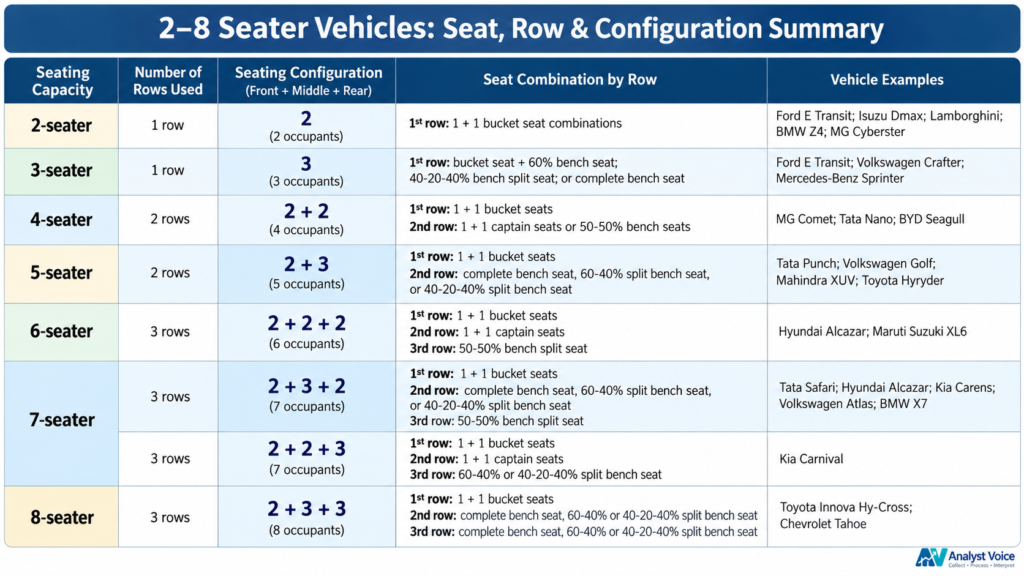
Every vehicle manufacturer has different cars for different purposes and with different seating capacities from 2 to 8 seats (there are vehicles too which go beyond this, like the Hyundai Staria). To achieve different seating capacities, OEMs use multiple seat rows and different seat configurations in each row to have 2- and 3-occupant seating capacities. Vehicles like vans and trucks, which are intended to carry loads, and some premium/sports cars usually have 1 seating row with 2–3 seating capacity, while vehicles intended for passenger use come in 2 to 3 rows having 4–8 seating capacity.
1. 2 and 3-Seater: Single Row Configuration
- 2 Seater Vehicles – Vehicles with 1 seat row provide 2 seating capacity with driver/passenger or LH/RH seats. 1+1 bucket seat combinations are used in such vehicles. Load-carrying vans and trucks like Ford E-Transit and Isuzu D-Max, and premium cars like Lamborghini, BMW Z4 and MG Cyberster have such seats.
- 3-seater Vehicles – These vehicles provide 3 seating capacity in their single seat row, which includes passenger/driver or LH/RH and center seats. Bucket seat + 60% bench seat, 40-20-40% bench split seat or complete bench combinations are used to have 3 seating capacity. These options are available mainly in pickup trucks and load-carrying vans such as Ford E-Transit, Volkswagen Crafter and Mercedes-Benz Sprinter.
4 and 5-Seater: Two Row Configuration
- 4 Seater Vehicles – In small cars or in the luxury category, such seat combinations are provided. The 4-seating capacity is divided into 2 rows with individual bucket seats, captain seats or 50-50% bench seats. In short, we can say that it is a 2+2 seat combination. For the first row, 1+1 bucket seats will be provided, and for the second seat row, 1+1 captain seats or 50-50% seats will be there. MG comet, Tata Nano, BYD Seagull is the example of 2+2 seating configuration.
- 5 Seater Vehicles – 5-seater is the most common seating configuration among all OEMs, which has 2 seat rows and a 2+3 seating configuration. 1+1 bucket seats are for first seat row and for second seat row complete bench seat, 60-40% and 40-20-40% split bench seats are used to achieve 5 seating capacity. Tata Punch, Volkswagen Golf, Mahindra XUV700 and Toyota Hyryder are examples of 5-seater vehicles.
6-Seater: Three Row Configuration
In this vehicle 2+2+2 seating configuration is used, and all the 3 seat rows will have 2 seating capacity. Companies provide this as an option to the 7-seater variant for people who want luxurious seats in the second seat row. For the 1st row, 1+1 bucket seats are used; for the second seat row, 1+1 captain seats are used; and for the 3rd row, a 50-50% bench split seat is used. Examples of this type of configuration can be seen in vehicles such as Hyundai Alcazar, Maruti Suzuki XL6 and other 6-seater SUVs and MPVs.
7-Seater: Three Row Configuration
In this vehicle, two seat types and combinations can be seen, like 2+3+2 and 2+2+3, which give 7 seating capacity in 3 rows.
- 2+3+2 configuration – In this configuration, we get 1+1 bucket seats in the front row for 2 seating capacity, while a complete bench seat or split bench seat (60-40%, 40-20-40%) will be used in the second seat row for 3 seating capacity, and the 3rd seat row will get a 50-50% bench seat, which again gives 2 seating capacity. This arrangement provides a good balance between second-row seating capacity and third-row packaging. Tata Safari, Hyundai Alcazar, Kia Carens, Volkswagen Atlas, and BMW X7 are examples of such configurations.
- 2+2+3 Configuration – This configuration uses 3 seating rows for 7 seating capacity, from which the front row will be equipped with 1+1 bucket seats, the second seat row will be equipped with 1+1 captain seats, which allow users more space and comfort and provide an entry option to the 3rd seat row, and the 3rd row will be equipped with either 60-40% or 40-20-40% split seats, which have a capacity for 3 occupants. Kia Carnival is a good example for 2+2+3 configuration.
8-Seater: Three Row Configuration
An 8-seater vehicle can use a 2+3+3 seating configuration, in which the front row will be equipped with 1+1 bucket seats for 2 seating capacity, and the second and third rows can use complete bench seats or 60-40% / 40-20-40% bench split seats for 3 seating capacity in each row. Toyota Innova Hy-Cross and Chevrolet Tahoe are examples of 8-seater vehicles with a 2+3+3 configuration.
Same seating rows but different seating capacity and configurations.
Seating configurations like 2+2+2, 2+3+2, 2+2+3 and 2+3+3 have the same number of seat rows, but all of them have different seating capacity configurations. All of these configurations depend on the need, as people who are concerned about seating capacity will go for 8-seater vehicles with a 2+3+3 configuration, and people who prioritize comfort will go for 6-seater (2+2+2) and 7-seater (2+2+3) configurations. The 7-seater 2+3+2 configuration stands out from an engineering aspect, as it respects packaging space at the 2nd and 3rd seat row locations.
Conclusions
Automotive seat configuration depends on various factors like comfort, requirements, seating capacity, packaging space and functionality. In this blog, we understood seat naming conventions by driver/passenger and LH/RH and saw how driver/passenger side seats change as per LHD and RHD. We also saw different types of seats like bucket, captain and bench seats used to have 2 and 3 seating capacities in the 1st, 2nd and 3rd seat rows.
We also saw how 1st, 2nd and 3rd row 2 and 3 seating options are used in different combinations like 2+2, 2+3, 2+2+2, 2+3+2, 2+2+3 and 2+3+3 to have 2–8 seating capacity in a vehicle. The selection of a particular configuration depends on the vehicle design, available space, occupant comfort, access requirements and luggage-space requirements.