We often hear people say “car headrest,” while some use the term “head restraint.” But which one is correct?
The headrest/head restraint functions both to provide comfort and support during normal driving and to provide safety during a rear collision. So, we can say that both terms are aligned with the functions of the component. However, “headrest” is the most common term used in the consumer market, while “head restraint” is more commonly used in automotive engineering.
To understand a head restraint, we first need to understand the meaning of the word “restraint.” A device that functions to limit the motion or displacement of a desired object is called a restraint. For example, safety belts, airbags, and child restraints limit or control the motion of the human body during a crash. Similarly, a head restraint is a device that helps limit the rearward movement of the head and the relative movement between the head and torso in the case of a rear impact.
Every OEM has its own comfort and safety design for head restraints, but everyone has to meet the mandatory regulatory safety standards required to launch a vehicle in a specific region. As the head restraint is one of the most safety-critical parts, it has to pass through multiple measurement parameters as well as safety requirements.
In this blog, we are going to see what a head restraint (headrest) is, its importance, how head restraints work, the different types, and the basic construction of the head restraint.
Table of content
What Is an Automotive Head Restraint?
An automotive head restraint is a device designed to support the occupant’s head and, more importantly, help protect the occupant during a rear crash by restricting or limiting the rearward displacement of an adult occupant’s head relative to the torso.
In a vehicle, the head restraint, or commonly called headrest, is also a safety-critical part along with systems such as the airbag, seat belt and child restraint systems. Because of its safety function, the head restraint has to meet various requirements related to its design, strength, dimensions and performance.
There are different types of seat orientations in vehicles, such as forward-facing, rearward-facing and side-facing seats, and the head-restraint design can vary depending on the seat application.
Nowadays, head restraints are provided in most vehicle seats and are available in different designs, such as adjustable and fixed head restraints, active head restraints, and two-way or four-way adjustable head restraints. Two-way adjustment can provide movement in the Z direction, while four-way adjustment can provide movement in both the Z and X directions, depending on the design.
If we look at vehicles around us, OEMs commonly provide adjustable head restraints in the front-row seats and fixed head restraints in some second-row seats. This is not a hard-and-fast rule, but it is a common approach, particularly in some entry-level vehicles.
What happens in rearward crash and how head restraint works
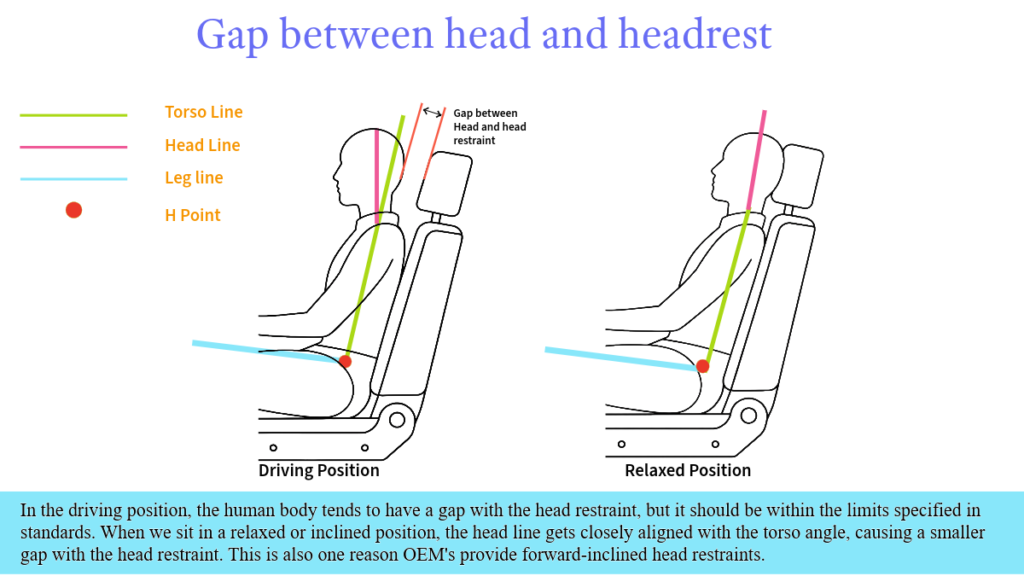
Head restraints are generally installed onto the backrest, which can be either fixed or adjustable. When we rest our back against the backrest, we can observe that our head is usually not in direct contact with the head restraint unless we intentionally move our head backward, or the head restraint is designed as an active or forward-inclining type. Basically, due to the structure of the human body and our normal seating posture, we usually notice a small gap between our head and the head restraint. If there is no head restraint, then our head remains without any direct support from the rear.
In the event of a rear crash, the vehicle tends to experience a rapid change in motion within a fraction of a second, while the human body tends to continue its motion due to inertia. Because of this difference in movement, our back comes into contact with the seat backrest, which provides support to the torso, but it does not immediately support the head. As a result, the head tends to move or rotate relative to the torso around the shoulder region, which can cause significant movement in the neck and may lead to neck or cervical-spine injuries, commonly referred to as whiplash injuries.
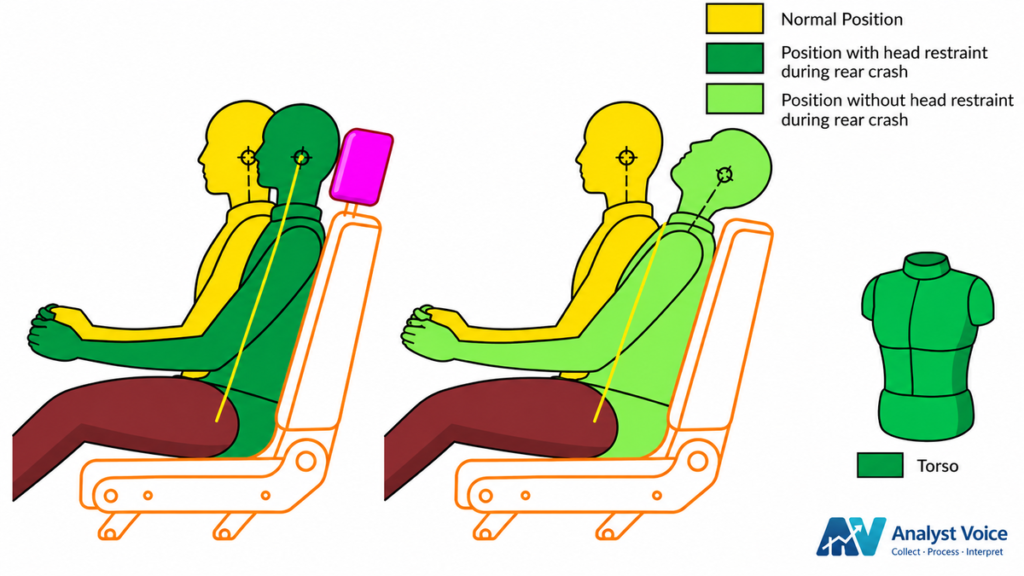
As discussed above, because of the normal human seating position, there is generally a gap between the head and the head restraint. If there is no head restraint, the head can move rearward without immediate support. The back or torso, where the main body mass is located, receives support from the backrest up to the shoulder region, while the neck and head remain unsupported. This creates relative movement between the torso and the head, with the head tending to rotate relative to the torso around the shoulder region.
So, the basic function of the head restraint is to restrict this rearward movement and rotational motion of the head by providing support behind it. This is the reason why the gap between the head and the head restraint is important and why the position of the head restraint is an important part of seat design.
Why distance between head and head restraint is important
There is multiple question around the internet like, my head should touch to the headrest ?